

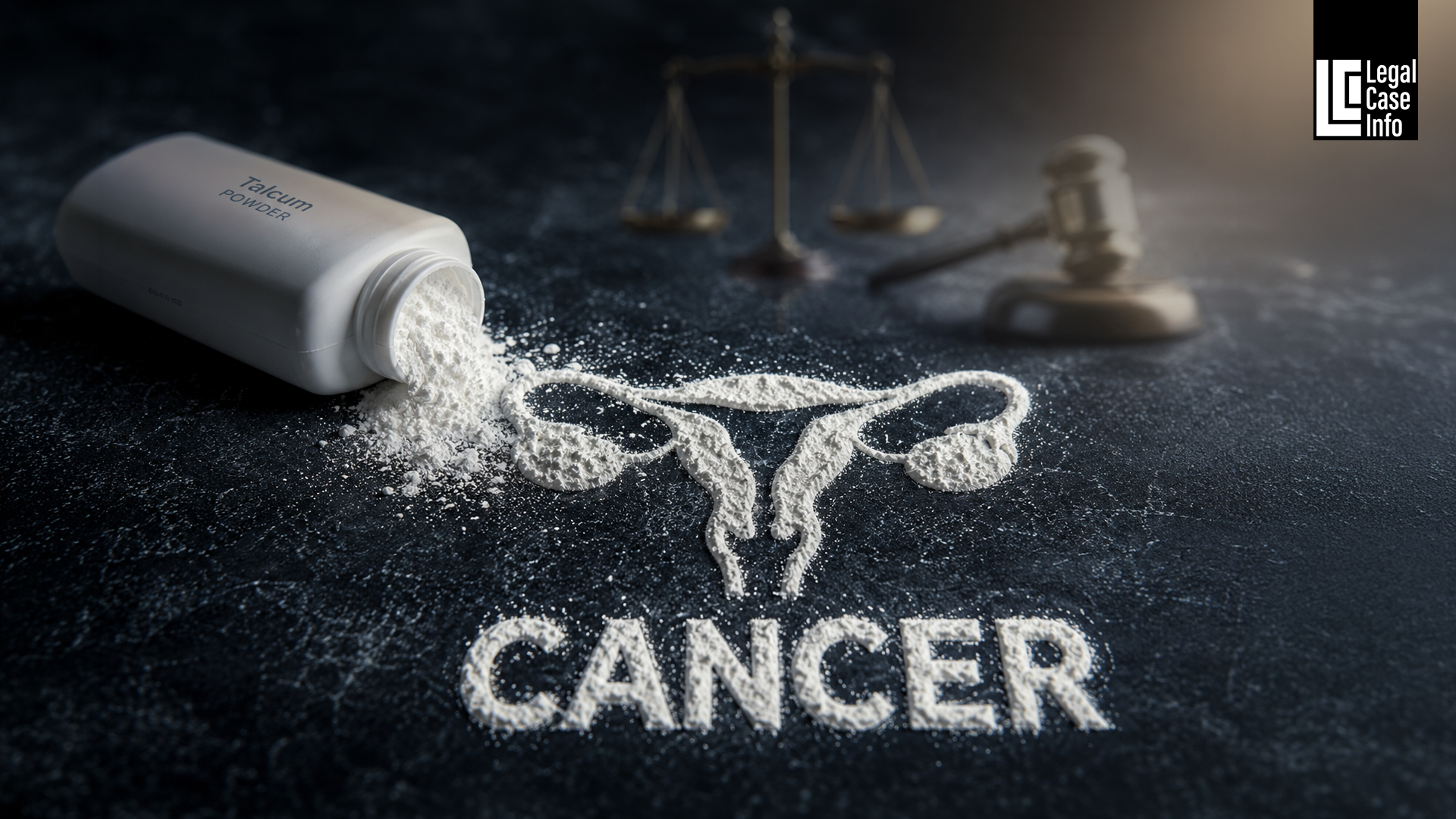

The talcum powder lawsuit centers on a product that was once considered safe for everyday personal care in American households. For decades, it was widely used in baby care and hygiene routines.
That trust has now been questioned. Research has linked regular talc use to ovarian cancer, and some studies have found asbestos contamination in certain talc products, which is associated with mesothelioma. Thousands of families have taken these concerns to court, with Johnson & Johnson at the center of most lawsuits.
Latest News on Talcum Powder Lawsuits
The litigation moves quickly, and the past several months have delivered some of the biggest developments yet.
June 2026: California jury orders J&J to pay $32 million in asbestos verdict
A Los Angeles jury awarded $32 million to the family of a California woman who died from pleural mesothelioma after exposure to asbestos-contaminated talc. J&J attempted to shift blame onto environmental conditions in Mexico City, where the plaintiff spent much of her life, but the jury assigned no fault to those conditions.
June 2026: J&J wins a Los Angeles jury verdict on ovarian cancer claims
Three families alleged that the company’s talc products caused ovarian cancer. In this second bellwether trial, the jury rejected the allegations of negligence and sided with the company.
April 2026: The Lancet retracts a 1977 talc study
The journal pulled a 1977 report on cosmetic talc after two researchers discovered the author had been a paid consultant to Johnson & Johnson. Defense teams had cited the study for years in talc trials.
March 2026: Judge cancels a $950 million punitive award against J&J
The court granted J&J’s motion to set aside the jury’s $950 million punitive award, ruling that the plaintiff did not prove the company acted with malice or concealed information it had a duty to disclose. The plaintiff’s family keeps the $16 million in compensatory damages already awarded.
February 2026: Pennsylvania jury awards $250,000 in an ovarian cancer case
The jury agreed that talc-based baby powder caused the plaintiff’s ovarian cancer and that J&J knew for years its products were dangerous without warning consumers. The award included $50,000 in compensatory damages and $200,000 in punitive damages.
December 2025: Baltimore jury orders $1.5 billion against J&J
Jurors sided with a Maryland woman who alleged that decades of talc use caused her peritoneal mesothelioma. The award included $59.84 million in compensatory damages, $1 billion in punitive damages against J&J, and $500 million against Pecos River Talc, a J&J subsidiary.
Where the Talcum Powder Litigation Stands in 2026
After years of legal maneuvering, the case against Johnson & Johnson has entered its most active phase. Every attempt to escape the claims through bankruptcy has failed, and the courts have cleared the path for trials.
- Every bankruptcy route has been shut down: Federal courts rejected J&J’s repeated efforts to offload talc liability into a bankrupt subsidiary, ruling the company was not in genuine financial distress.
- More than 68,000 active cases are pending: The federal MDL in New Jersey holds the largest active mass tort docket in the United States, and new claims continue to arrive each month.
- A court-appointed mediator is overseeing settlement talks: High-level mediation is underway as both sides weigh whether to resolve the claims outside the courtroom.
- Expert testimony has been cleared to reach juries: Plaintiffs’ experts may testify about the link between talc and ovarian cancer, a decision that keeps the core cases alive for trial.
- Bellwether trials are on the horizon: Test cases at both the state and federal level will shape how the rest of the litigation unfolds.
- The filing window remains open, but not indefinitely: New claimants can still come forward, though deadlines tied to state law eventually close the door.
Who Qualifies for a Talcum Powder Lawsuit?
Eligibility comes down to a few clear factors tied to product use, diagnosis, and timing. The points below outline who generally has grounds to pursue a claim.
- Long-term talc use: Consistent use of a talc-based product, whether the baby powder or the intimate hygiene variety.
- Cancer diagnosis: A diagnosis of ovarian cancer or mesothelioma.
- Filing timeline: Most states allow one to three years from diagnosis, since these diseases often surface many years after exposure.
- Surviving family members: Relatives may qualify to file if the person who used the product has passed away.
What is Talcum Powder?
Talcum powder is a fine cosmetic powder made from talc, a soft mineral that absorbs moisture and helps reduce friction on the skin. For more than a century, it has been used in everyday products like baby powder, body powder, deodorant, and cosmetics.
Talc feels soft, keeps the skin dry, and helps prevent chafing, which is why it became so common in households. But the main concern is where talc comes from. Talc is a natural mineral formed from magnesium, silicon, and oxygen, and it is often found in the earth near asbestos deposits.
Because of this close connection, there is a risk that talc can become contaminated with asbestos during mining. This possible contamination is the reason behind many safety concerns and legal cases linked to talcum powder.
How is Talc Powder Linked to Cancer?
The link runs along two separate paths, one involving talc itself and one involving the asbestos that can travel with it. Each path connects to a different disease, and both are central to the lawsuits.
Talc and Ovarian Cancer
When applied to the genital area, talc particles can move through the reproductive tract and settle in the ovaries, where they trigger inflammation.
Scientists first found talc particles embedded in ovarian tumors in the early 1970s, and that discovery became one of the earliest warning signs.
Talc, Asbestos and Mesothelioma
Asbestos is a recognized carcinogen that occurs naturally alongside talc in the ground. When asbestos fibers become airborne and are inhaled, they lodge in the lining of the lungs and are strongly linked to mesothelioma. Some batches of powder have tested positive for asbestos, which connects the product directly to the disease.
Symptoms of Ovarian Cancer
Ovarian cancer is difficult to catch early because its warning signs are easy to mistake for everyday discomfort. The symptoms below are not proof of cancer, but they are worth watching, especially when several appear together or persist.
- Abdominal bloating or swelling
- Unexplained weight loss
- Changes in bowel habits, such as constipation
- Discomfort in the pelvic area
- Ongoing fatigue
- Back pain
- Frequent urination

How is Ovarian Cancer Diagnosed?
Diagnosis usually begins once symptoms appear and follows a series of steps that move from physical examination to laboratory and imaging work. Doctors combine several methods before confirming a result.
- Pelvic examination: The doctor examines the external genitalia and checks internally, pressing on the abdomen at the same time to feel for anything unusual.
- Imaging tests: Ultrasound and CT scans of the pelvis and abdomen give a clearer view of the ovaries and surrounding tissue.
- Blood tests: These check organ function and look for markers that can signal cancer.
Treatment Options
Treatment depends on how advanced the cancer is and the patient’s overall health. In most cases, doctors combine multiple approaches to improve effectiveness and reduce the chance of recurrence.
- Surgery: It physically removes the tumor from the body. In some cases, doctors may also remove nearby affected organs or tissues if there is a risk that cancer has spread locally.
- Chemotherapy: Strong anti-cancer drugs are circulated through the bloodstream to target and destroy cancer cells throughout the body. It may be given before surgery to shrink tumors or after surgery to eliminate any remaining cancer cells.
- Radiotherapy: High-energy radiation beams are focused on a specific area of the body to damage and kill cancer cells. It is designed to minimize harm to surrounding healthy tissue while targeting the tumor site.
- Hormone Therapy: Hormone therapy works by lowering hormone levels or blocking their effect, which can slow down or stop tumor growth.
- Immunotherapy: Helps the body’s immune system detect and attack cancer cells more effectively. It strengthens natural immune responses, especially in cases where cancer cells are able to hide from the immune system.
Studies and Statistics
The scientific record behind these cases has grown steadily, and the numbers explain why the concern keeps building. The figures below anchor the medical and legal debate.
- Ovarian cancer affects roughly 20,000 women in the United States each year, accounts for about 1% of all cancers, and ranks as the fifth leading cause of cancer death among women.
- A 2024 NIH and NIEHS analysis using the Sister Study, which followed more than 50,000 women and was published in the Journal of Clinical Oncology, linked genital talc use to a higher risk of ovarian cancer. The strongest associations were among frequent, long-term users and among women who used it during their reproductive years.
- The World Health Organization’s International Agency for Research on Cancer classified talc as “probably carcinogenic to humans” in 2024, drawing on strong evidence from animal and cell studies alongside limited human evidence.
- Meta-analyses of case-control studies found that regular genital talc use is associated with about a third higher risk of ovarian cancer.
The Talcum Powder Lawsuit Against Johnson & Johnson
Johnson & Johnson is the primary defendant, and for good reason: the company built its reputation on talc and marketed it as safe for decades. The lawsuits argue that this reputation hid what the company knew internally.
Court records show that J&J’s own testing confirmed asbestos in its talc during the 1970s, yet no warning labels were ever added. The first mesothelioma lawsuit came from Darlene Coker in the late 1990s, but she could not obtain the company’s internal documents, and her case was dropped.
Decades later, litigation forced J&J to hand over internal memos revealing that company audits in the 1970s had found unusually high amounts of asbestos in talc samples. Once those documents surfaced, the lawsuits began piling up and the evidence against the company grew.
J&J eventually stopped selling talc-based powder worldwide and shifted to a cornstarch formulation.
The Texas Two-Step and J&J Bankruptcy Attempts
Rather than confront the mounting claims directly, Johnson & Johnson turned to a legal strategy known as the Texas Two-Step. It let the company address mass tort liability while its core business kept running.
The maneuver relies on a provision of Texas law, Chapter 10 of the Texas Business Organizations Code, that allows a company to split into two entities. One entity keeps the assets, and the other absorbs the liabilities before filing for bankruptcy.
J&J divided itself into LTL Management LLC, which took on the talc liabilities, and Johnson & Johnson Consumer Inc., which held the assets. LTL then filed for bankruptcy.
Federal courts rejected the strategy repeatedly, finding that J&J was not in real financial distress, and the litigation was sent back to the courtrooms.
Other Companies Named in Talcum Powder Lawsuits
Johnson & Johnson draws the most attention, but it is far from the only company facing talc claims. Several manufacturers and suppliers have been named as the litigation has widened.
- Cosmetics makers: Avon, Revlon, and Colgate-Palmolive.
- Miners and suppliers: Whittaker, Clark & Daniels.
- Foot care brands: Merck and Bayer, tied to Dr. Scholl’s and Lotrimin foot powders.
Talcum Powder Verdicts and Settlements
The courtroom results tell a story of large jury awards paired with settlement efforts that keep collapsing. The verdicts below mark the most significant moments, followed by where settlement talks stand.
- $4.69 billion, St. Louis (2018): Awarded to 22 women and their families who alleged that asbestos-contaminated talc caused their ovarian cancer, the largest group award in the litigation.
- $1.5 billion, Baltimore (2025): The largest single-plaintiff verdict to date, tied to a peritoneal mesothelioma diagnosis.
- $966 million, Los Angeles (2025): A mesothelioma wrongful-death award later reduced to $16 million after the court set aside the punitive portion.
- $260 million, Oregon: Another verdict favoring a plaintiff who linked talc use to cancer.
On the settlement side, J&J floated bankruptcy-based plans ranging from roughly $6.5 billion to $9 billion, and each one collapsed under legal challenge. As of mid-2026, no global settlement has been finalized, and mediation continues.
FDA and Regulatory Efforts
Regulators have moved on talc, though not in a straight line. The back-and-forth reflects how contested the science and politics around the mineral remain.
In December 2024, the FDA proposed a rule requiring standardized asbestos testing for talc-containing cosmetics, the first federally enforceable testing standard of its kind.
In November 2025, the agency withdrew that proposal, citing public opposition and technical concerns, while stating it intends to issue a new version to meet its obligations under the Modernization of Cosmetics Regulation Act. For now, consumer protection on talc testing sits in limbo, with no firm timeline for a replacement rule.
How to File a Talcum Powder Lawsuit?
Filing a claim follows a clear sequence, from confirming eligibility to building a case with the right legal support. The process includes:
- Determine eligibility: Confirm consistent, long-term talc use and a diagnosis of ovarian cancer or mesothelioma.
- Gather documents: Collect medical records, pathology reports, purchase receipts, and any witness statements that support the claim.
- Work with an attorney: Choose a lawyer who focuses on personal injury, toxic exposure, or product liability, who can advise on joining the MDL or filing an individual lawsuit.
Statute of Limitations for Talcum Powder Lawsuit
The deadline to file depends heavily on where the claim is brought, and missing it can end a case before it begins. Timing is one of the most important factors a claimant needs to understand.
Limits vary by state, and they are generally tied to the date of diagnosis rather than the last time the product was used. Because these diseases can take years to develop, the window remains open for many claimants, but it will not stay open forever. Anyone considering a claim benefits from checking their state’s specific deadline early.


